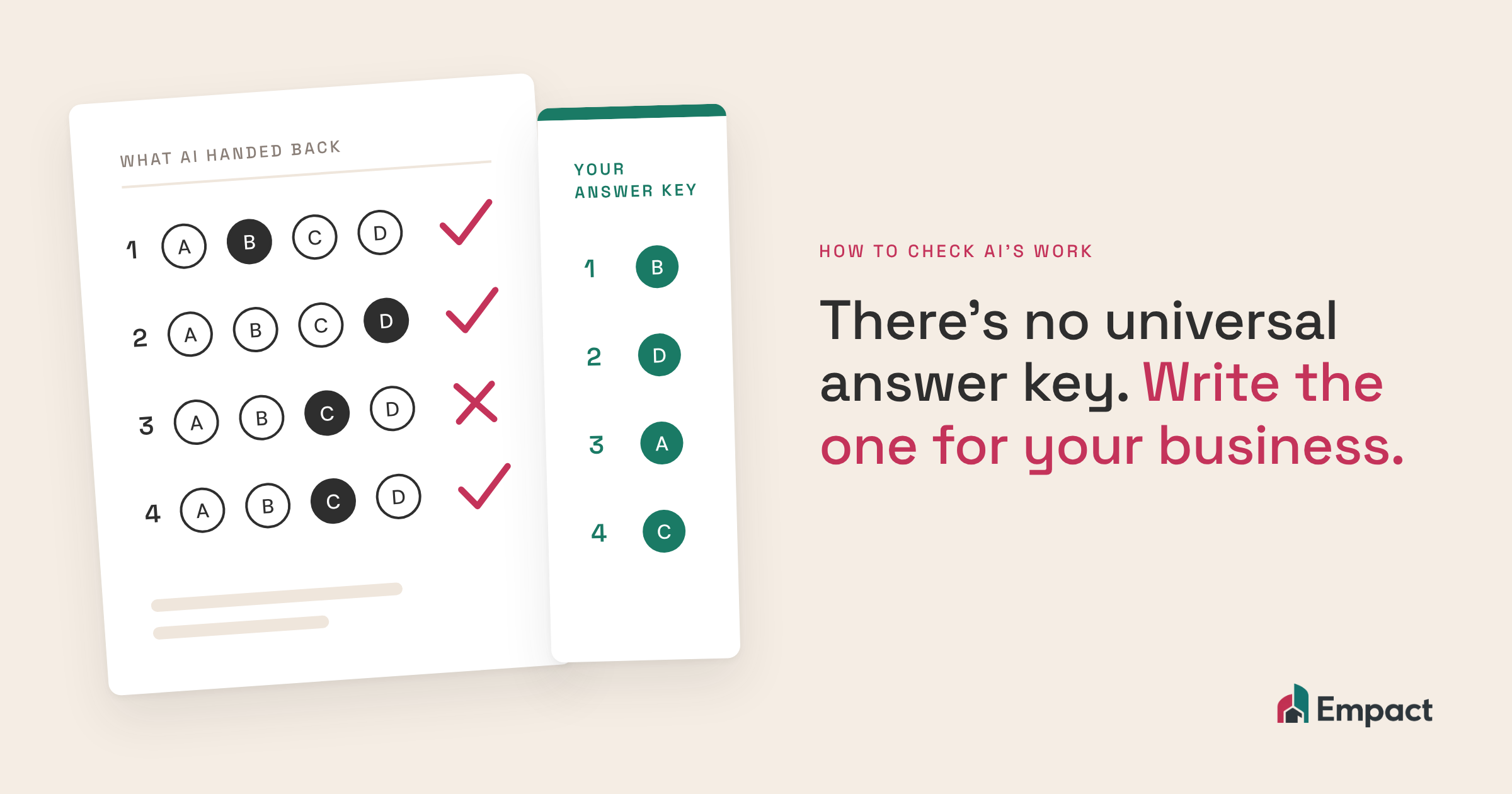
The short version: You check it against a written standard of what good looks like for your business, not against your gut. Wrong AI output rarely looks wrong; it looks polished and generic, or it's built on something your business doesn't have. Written criteria, written limits on what you actually have, and examples of good and bad give anyone who knows the business something to check against. The expert comes in upstream, getting that standard out of people's heads and into a form your AI tools can use, then sharpening it as misses turn up.
Your AI tools can hand your team advice that sounds sharp and doesn't fit your business. One story I've heard in the wild: AI recommended posting a piece of content to the brand's video channel, a solid tactic for that type of business, except the brand didn't have a video channel.
Some AI output is so far off you feel it right away. This one sounded smart, and that's the danger: a team without a marketing background reads it, likes it, and someone starts the channel with no plan for how it fits the rest of the marketing. At best it's wasted effort; at worst it's a hit to the brand.
I attended the Small Business Summit in Toronto this fall, and what stood out was the emphasis on domain expertise: someone who knows what good looks like has to judge what goes into AI and what comes out. It also made me think about how few businesses have an expert for every domain. On a lot of lean teams, marketing is nobody's job yet or it's one generalist doing everything, so how does that team check the work?
Why does wrong AI output look right?
AI fills in the blanks. It's a very agreeable tool and it will always try to give you an answer; without your business to go on, that answer comes from the average of a lot. There's a separate post on why AI defaults to the average, and what matters here is that the average sounds confident.
That produces two kinds of plausible-wrong. The first is generic advice: it sounds smart and sure of itself, and it's what everyone else is getting too, which strips out the thing that makes your brand you.
The second is a plan built on something you don't have, whether that's a channel, a tactic or a campaign you don't have the budget or the people for. The video channel lives here.
The big misses announce themselves; the small ones look about right, and a team without the background to question them acts on them.
Can you check AI's work if you're not the expert?
Yes, against a standard instead of instinct. It feels like a knowledge problem, like we're not expert enough to judge it. The real gap is that the standard for good was never written down, so nobody can check against it, not even an expert who joins later. Reading more carefully doesn't fix that; without a standard, careful reading still lets through advice that only sounds like a solid idea.
Take a target buyer described as "a high-growth company." That's not enough for AI to go on; it will define high growth on its own terms, and the list it hands back will match a definition nobody on your team agreed to. Write it down concretely instead: revenue growing by a set percentage year over year, a particular hiring pattern, a recent funding announcement. Now the AI has something to search for and judge against, and the reviewer has something to check: does this account show the signal or not? You don't need a marketing background to answer that.
Limits work the same way. Once the channels you run, the budget you have and the people you have are written down, "post this to your video channel" fails the check on its own. Examples of good and bad output give the reviewer something concrete to compare against, and the AI can tag each claim as seen or guessed, with a link to the evidence for anything it says it saw, so the reviewer can click through and check it. Built right, AI can help with checks like these; a person still makes the call, ideally whoever owns that kind of task.
Shape the output for whoever checks it, too. Something else from the summit was a good reminder: you can't hand someone a 24-page report and expect them to read it and make a good call. A check nobody can really do is a check nobody really does, so put the takeaway and the evidence up front and move the long material to an appendix.
Where does the expert actually come in?
Upstream, and in the feedback. The expert's job is to turn what good looks like into criteria, examples of good and bad, and limits on what the business does and doesn't have; anyone who knows the business can then check against it.
A team can start this alone. Write down, at a high level, who the business is, who it serves, what problem it solves and why it's different, then give that to your AI and ask it to interview you so it pulls the detail out of you. That start is worth doing whatever comes next.
Where it gets hard is the words. Your team knows the business and may still not have the marketing vocabulary to describe your ideal client or brand precisely enough for AI to work from; someone with that expertise can draw it out and write it in a form AI can read. Whether to learn that yourself or bring someone in is a fair question, and I've written about deciding where AI fits in your marketing with both paths on the table.
Expert judgment also comes in through the gray zone: output that looks about the right shape, but something is off. Treat that feeling as a missing criterion. Picture an account the AI flags that looks right on every count but sits in a geographic market the business can't serve; that rule was never written down, and now it is, so the next check catches it. Each miss makes the standard sharper, and it helps to map where a person steps into an AI workflow so those checks happen at the right points.
How do you start checking AI's work this week?
Test, then trust: hold the output against what you've written down, and trust it as it holds up.
This week, write that one page about who you are and add a short list of what you don't have, like the channels you don't run and the budget you don't spend. Then hold the next smart-sounding recommendation against it before anyone acts on it.
For teams that want help writing the standard, that's what Foundation is for. I interview your team, push back where the answers are vague, and write your brand, voice, offering and ideal-client documents in a form your AI tools can use, plus a "how the work gets done here" doc for your most repeated marketing tasks, checks included.