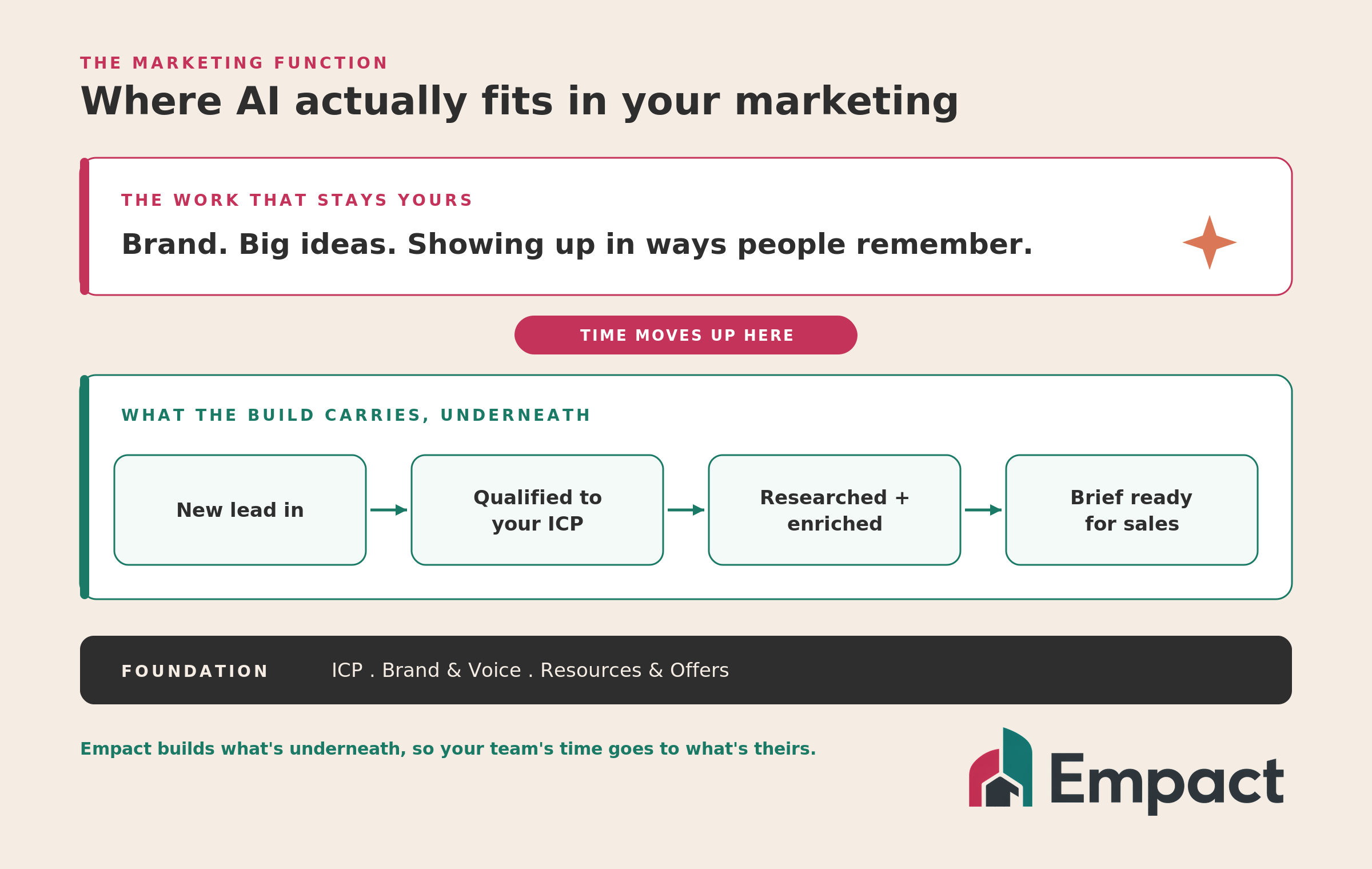
The short version: AI fits underneath your marketing, in the work that runs below the surface. It reads from a foundation, your business context and instructions, works your data, and runs the repetitive workflows, with a person in the loop on the decisions that matter. Your team doesn't have to learn how that gets built. They learn the part that touches their role and spend the rest of their energy on the marketing work that's theirs. Learning all of it yourself is possible, but it costs more time and attention than most teams at capacity can spare.
When a founder or a marketing lead decides AI belongs in their marketing, the plan almost always carries a hidden line item: someone is going to have to go learn AI. Usually that someone is a marketer who is already stretched, or the founder already wearing five hats. The decision was sound. The assumption sitting underneath it, that using AI means a person has to go learn AI, is what quietly stalls everything, and it's worth pulling apart, because it isn't true the way people think it is.
What "learning AI" actually involves
Marketers have always been the ones who learn the new thing. Social media landed and marketing figured it out. Search changed and marketing learned SEO. Every time a new technology turns into a new channel, marketing is the function that has to make sense of it. So this isn't about whether marketers are willing or able to learn. They are, and they have, over and over.
AI is a different kind of beast. It isn't one channel or one best practice you can read up on and apply. It's a stack of things working together: the business context and instructions the AI reads from, the data it works with, the workflows it runs inside, the agents that carry out steps on their own, the review point where a person checks the output, and a frontier that keeps moving, like the separate discipline of getting your business found when someone asks an AI who to call. "Learn AI" waves at all of that as if it were a single skill. Asking a busy marketer to learn the entire stack before any of it pays off is how you get a half-built workflow and a frustrated person who still has their actual job to do.
You can learn it yourself, but know what that takes
None of this means doing it yourself is off the table. You can commit to it, carve out the time, pay for real training, and give your team the space to come up to speed. That path is real, and for the right person it's a good one.
What it asks for is easy to underestimate. Wanting to learn it is not the same as having the drive to. Drive is what gets you to the lesson, gets you to pay for the thing, and gets you back to it when it's tedious, because no one else is going to make you do it. It's closer to keeping up a workout than reading a manual once. It also takes ongoing maintenance, because this isn't something you learn once and then know forever. The tools and use cases and features shift month to month, and what you worked out in the spring is partly out of date by the fall. And it takes a certain temperament, the kind that's content chasing a moving target. Some people are built that way and enjoy it. Plenty of capable people aren't, and shouldn't have to pretend otherwise. When you're already running flat out to keep the business going, the time, the money, and the headspace this asks for are usually what you have least of.
So the honest answer is that you can learn it yourself. The real question is whether the cost of doing that fits the team and the moment you're actually in.
The other path: build it, and point your energy where it counts
The alternative is to hand the building to someone who understands how your marketing actually runs, including where it hands off to sales, and who can also do the technical work. That keeps the learning curve on your side small and specific.
The setup has a shape to it. First comes the foundation, which is really about understanding the pieces that feed your marketing and getting them to work together: your ICP, your brand and voice, and a clear handle on your resources, offerings, and solutions, so everything stays consistent and on-brand. Get that part wrong and everything built on top of it is off, which is why it comes first.
This is also where having a marketer who can build the technical piece earns its place. You might believe you know your ICP, and you might not, fully. Bringing someone in is the chance to stress-test it against your current best customers, work backward from your actual customer list, and make sure you're still talking to the people who see the value and want to buy from you. The workflows then get built on a foundation you've checked, not on an assumption.
On top of that foundation run the workflows and agents, built inside the tools you already use, with you looped in wherever a real decision gets made. The case for why this beats hiring another body or buying a tool that runs on its own is its own piece.
Most of that build is the work that never shows. A lead comes in, and before anyone acts on it, it gets qualified against your ICP, checked for whether it's a real opportunity, and researched across public and enrichment sources, so you understand who they are and whether they're even in a buying moment, because plenty of accounts aren't. Then it comes back as something a person can act on: here's the account, here's what matters about them, here's how your brand can help, here's who to reach out to. A marketer can do all of that by hand. It runs to hours per account, and it usually means dragging the work from one AI chat to the next to stitch together a brief for sales. Built as a workflow, it just runs, and your team gets the finished brief to confirm instead of assembling it from scratch.
When the setup carries that load, your team's energy goes where it actually matters: the brand, the out-of-the-box ideas that set you apart in your industry, and showing up in front of your audience in ways people remember. Instead of spending a morning working out which events are even worth attending, your team already knows, and can put that time into how to show up and be worth talking to once they're there, or how to pull the right people into a side conversation. That's the work that's theirs, and it's the part most marketers got into this to do.
What your team learns is narrow and worth their time: how to run the workflow that touches their role, where they sign off, how to read what it gives back, and when to trust their own judgment over it. What they never have to learn is what an agent is, how to connect it to your data, or how to stress-test it before it touches a live lead. That part gets built and handed to you, documented, with no retainer and nothing you stay dependent on.
Where this leaves you
Whether you run marketing yourself or lead a small team, you already know AI belongs in your marketing. The real question is how your people get there, given the time and attention you actually have to spend.
Staying current with this takes a particular temperament, and at Empact that's what we bring. Founder Alexandra Franco has spent close to two decades in marketing and the last few years building with AI tools. Building the setup right means the people running your marketing learn the part that's theirs and put the rest of their time into the work they're great at.