Why more marketing activity won't bring you more clients
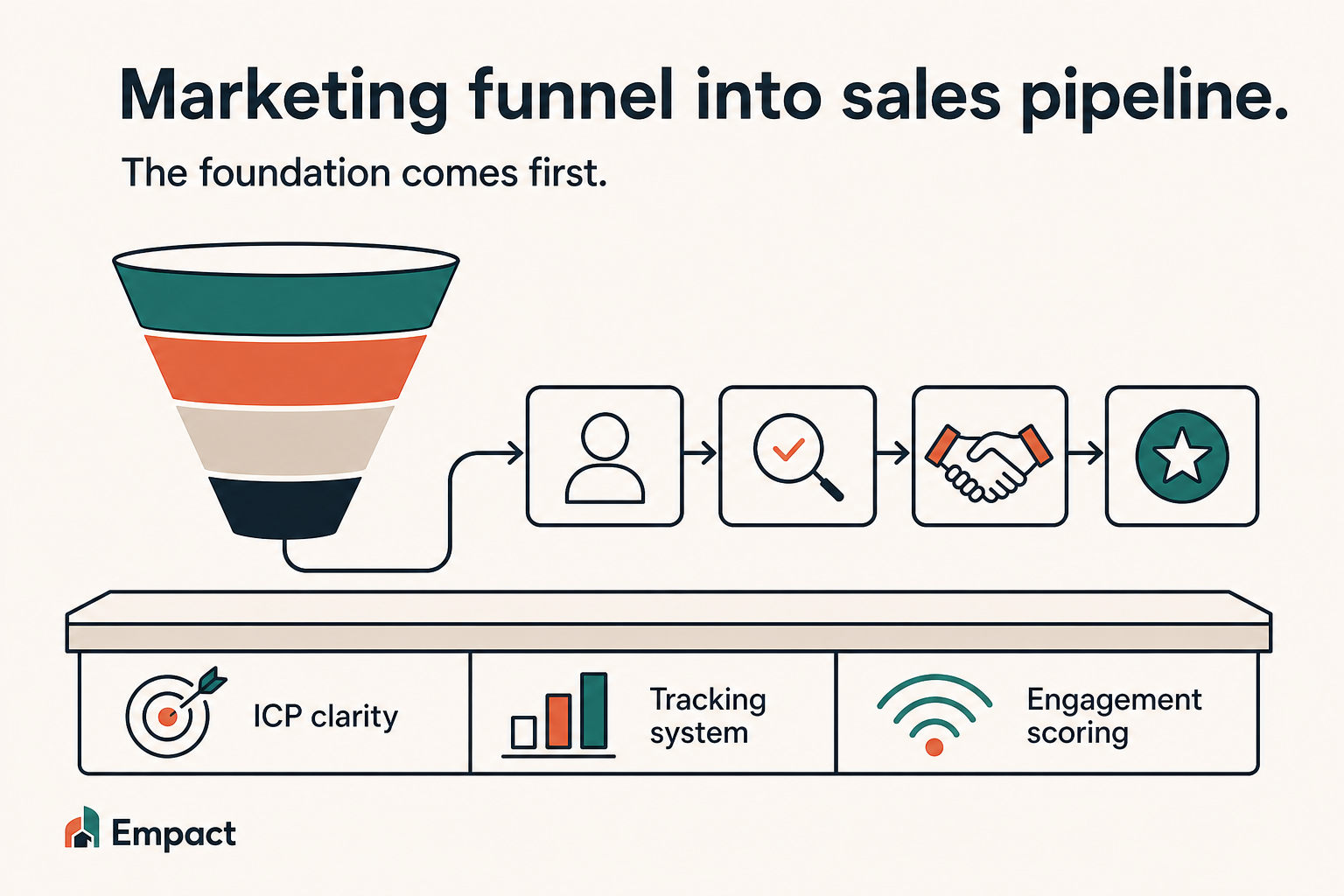
> The short version: More content, more outreach, and more ad spend can't fix the real problem. When the underlying foundation is missing, more activity just creates more noise. Fix the foundation first. Then activity compounds.
When results feel flat, the instinct is to do more: more content, more outreach, more channels, more ad spend. That logic is reasonable — more input should produce more output. The problem is that it only holds when there's a working system underneath. Without one, more activity doesn't produce more results. It produces more of nothing.
This isn't a reflection on effort. The effort is real. The problem is where it's going.
The funnel has to work before activity matters
Marketing is supposed to warm up the right prospects over time and hand the warm ones to sales. Sales then advances those conversations toward a decision: is there a real problem here, the right fit, and the practical ability to move forward? When the answer is yes, it becomes a genuine opportunity. That sequence is the funnel feeding into the pipeline.
But the sequence only works if marketing is reaching the right people in the first place. If it isn't, sales is starting cold every time, regardless of how much activity is happening upstream. Volume without direction doesn't fill a pipeline. It fills a calendar.
Three things that have to be in place first
Who you're actually trying to reach. An ideal client profile (ICP) is not a demographics checklist. It's built from understanding who you've won and lost with: what circumstances they were in, what problem you were actually solving, and what made the timing right for them. Without that grounding, outreach is aimed at an assumption, not a real pattern.
A system to track what's happening. A spreadsheet with contacts is a legitimate starting point. The goal is structure: a way to understand what you know about each account, what's been tried, what the response has been, and where things stand. A CRM gives you that structure. With the tools available today, setting one up doesn't require a developer or a large budget. Any information you already have can move into a more organized system over time. The point isn't perfect infrastructure — it's organized information.
The ability to see who's actually engaging. Not all activity signals the same level of interest. Someone who reads a blog post is at a different stage than someone who registered for a webinar, showed up live, and asked questions. These signals carry different weight, and a system that can distinguish between them lets you focus on the accounts actually moving toward a decision, rather than spreading attention evenly across everyone.
What happens without these in place
When the foundation is missing, activity produces noise. Content goes out but there's no way to tell what's landing. Outreach happens but there's no signal for which accounts to follow up with. Campaigns run but nothing closes the feedback loop, so it's impossible to learn what's working or improve from it.
This is usually what teams are describing when they say they've tried more channels and nothing has changed. The channels weren't the problem.
What changes when the foundation is in place
Once you know who you're targeting, have a system to track their activity, and can distinguish engaged signals from passive ones, the dynamic shifts. You follow up with the accounts that are actually showing interest. You see what messages are resonating and do more of that. The feedback loop closes. Marketing starts to generate real information, and that information tells you what to do next.
Activity starts to compound instead of cancel itself out. That's the difference between a marketing system and marketing effort.
Where to start
Not all of this has to be built at once. The most important first step is usually getting clear on who you're actually trying to reach, grounded in what has worked before rather than assumptions about who should theoretically be a good fit. Everything else gets sharper from there.
If you're not sure where your system is breaking down, why your B2B marketing isn't generating consistent leads is a good place to understand the pattern. When you're ready to do something about it, Start Here is the right next step.