Why Your B2B Marketing Isn't Generating Consistent Leads (It's Not a Tactics Problem)
Most B2B founders and marketers at small companies aren't doing nothing. They're doing a lot, from referrals, outreach, content, tools, to a full blown GTM strategy. And yet pipeline stays unpredictable. More activity (or random acts of marketing) doesn't fix it.
The problem is almost never the tactics. It's the scaffolding underneath them.
You've Done the Work
This isn't for the person who hasn't tried anything.
Whether you have a full marketing strategy in place or you've been running on referrals and reputation for years, you've figured out how to get clients. That's real. The frustration is that it doesn't compound the way it should. You're putting in the effort, and the results are still inconsistent.
That gap has a specific cause.
The Misdiagnosis
When deals aren’t coming in the default is to look at sales. Are we closing enough? Are we following up fast enough? Is the team not prospecting hard enough?
Sometimes. But more often, what looks like a sales problem is a visibility problem - and visibility is an infrastructure problem.
The real question is whether your marketing system is surfacing the right opportunities for sales to act on in the first place - and whether marketing and sales can actually see what's happening between them. Which leads came in and why. Which ones converted. Where the qualified ones are stalling.
Without that visibility, both teams work harder. But they're working without context.
The Missing Layer
Here's what's often happening in most small B2B companies: the inputs exist, but there's no orchestration layer connecting them.
Your data lives in three places. Campaign results sit in a platform. The context for why a deal went cold lives in someone's memory. Content that performed last quarter isn't influencing what gets created this quarter. Everything is technically in motion, just not in communication with itself.
This is the infrastructure gap. The scaffolding, the harness that should hold everything together - making it visible, actionable, and compounding - isn't there, yet. And it's why adding more tactics almost never solves the problem (in fact it can add to the mess). You can't optimize a system that doesn't exist.
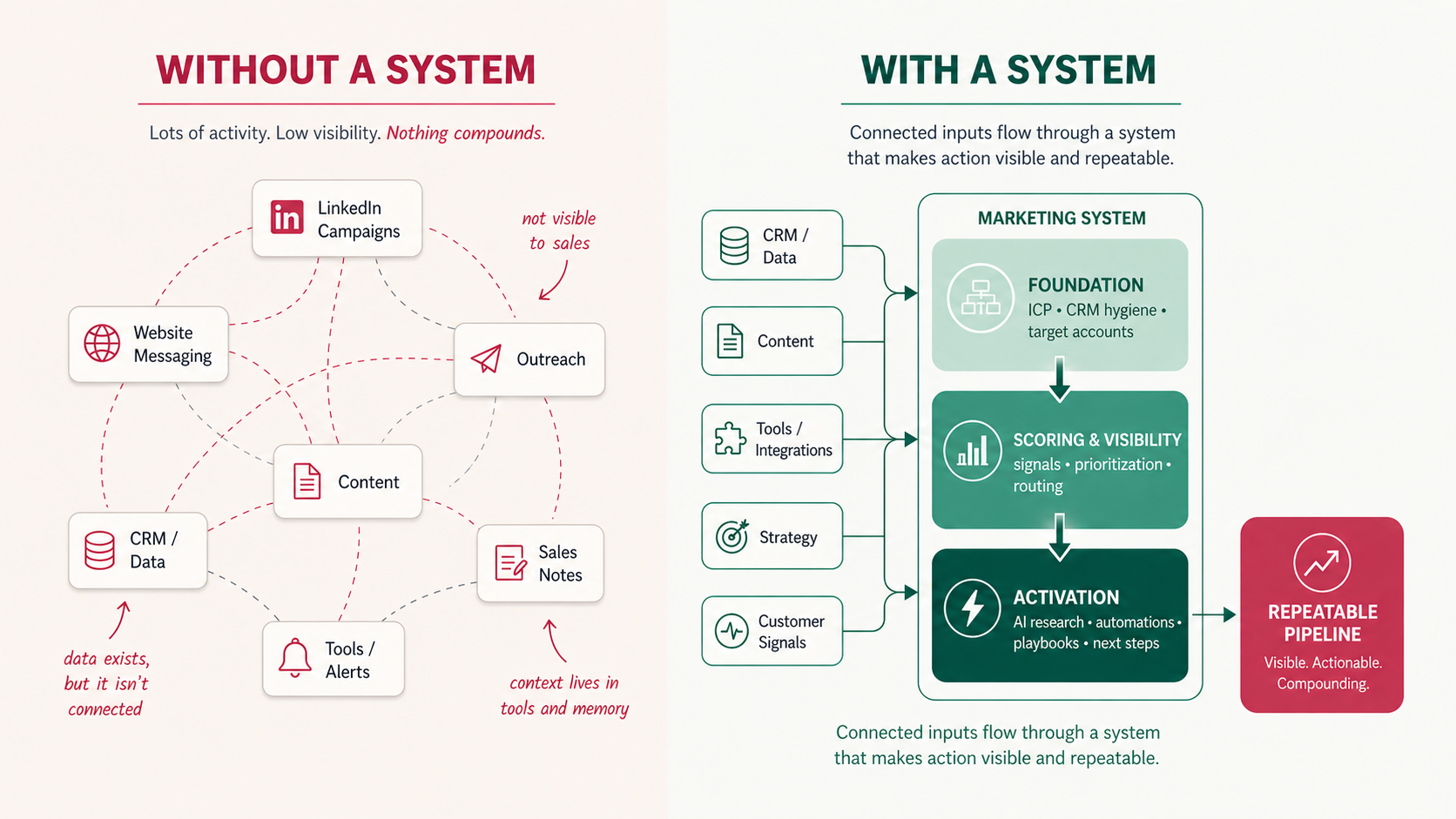
Without an orchestration layer, marketing inputs — outreach, content, tools, data — operate in silos. The system is what connects them to consistent pipeline.
What the Orchestration Layer Actually Does
A marketing system - the infrastructure, the scaffolding, the AI harness - isn't a strategy doc or a new hire. It's the layer that connects your work to your outcomes and keeps that connection visible, and when built intentionally - also actionable.
When it's in place, a few things become true:
Your ICP is defined and working. Not just documented somewhere - actually shaping what you write, who you target, and what you measure. And worth knowing: as you build the system, you'll often find the ICP needs to be revisited. It evolves. The system surfaces that.
You can see what's moving. Not just lead volume - lead quality, source, conversion patterns. The information exists to make real decisions instead of guesses.
The work compounds. When something performs, you catch it and use the signal. When outreach to a segment isn't converting, you catch that too, before spending another quarter on it.
And critically: a human is still in the loop. The orchestration layer doesn't run your marketing for you. It makes the judgment calls visible so the right person, whether that's you, your marketer, or both, can actually act on them. The system creates the conditions for good decisions. The human makes them.
Why Building It Is the Hard Part
The gap isn't awareness - most founders know the infrastructure is missing … all it takes is a few minutes on LinkedIn to recognize the options seem both limitless and overwhelming.
What it really takes to build is two skill sets that rarely live in the same place.
Marketing judgement (strategy & execution) and systems design are different disciplines. Great marketers know how to build a brand and trust, or which channels to build campaigns around, or how to generate demand, and so much more. A systems builder knows how to structure data, connect tools, document workflows, design feedback loops, and bring in the right automation without removing the judgment that needs to stay human. Both experiences take time to develop - and asking one person to have both it all demands a high cost.
That's the gap Empact exists to fill. Not to do your marketing for you, but to build the infrastructure that makes your marketing actually work, with the foundation of nearly 20 years of marketing experience.
Where to Start
Before a new channel, a new campaign, or another tool - start with visibility.
Can you see, right now, what's actually happening in your pipeline? Where leads are coming from, where they're stalling, what's converting and what isn't?
If the answer is no, that's the first thing to build. Everything else follows from there.
Curious what a marketing system could look like for your business? That's exactly where the conversation starts. Let's talk →