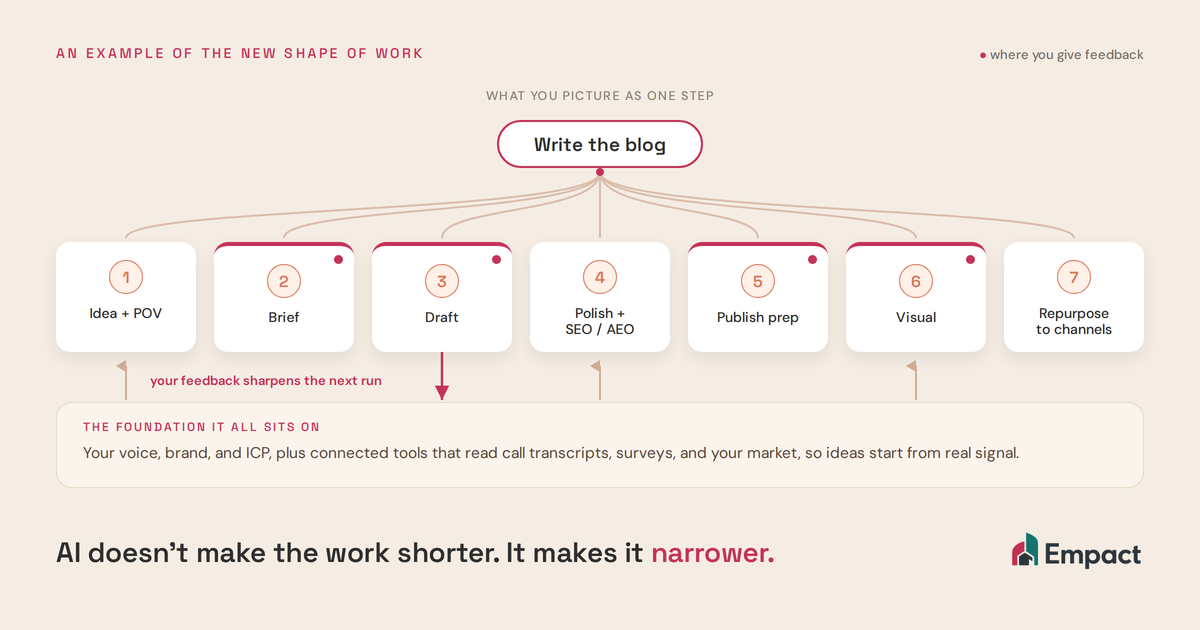
The short version: AI reinvents a task more than it speeds one up. Writing a blog already has clear phases, and AI re-cuts them into narrower steps, each doing one specific thing and handing it down the line. Some of those steps are new. It runs faster than doing it by hand. It also has more steps than the process you started with, and every step is a place a specific input goes in and a place a person catches what's off before it carries forward. Collapse it all into one prompt and you get the most average version of the work. You don't have to build a big system to use AI well, but you do have to see the real shape of the task and know where you step in.
Bolting AI onto a process you already have doesn't work. Writing a blog has clear phases: the idea, the brief, the draft, the edit, publishing. Hand one of those phases to AI as it is, and what comes back is the average version. It's the re-cut that's different. Done well, those phases break into narrower steps, and some of the steps are new.
Does AI actually mean fewer steps?
No. The phases you already know get re-cut into more, narrower steps.
Think about what writing a blog with AI actually takes if the output is going to be any good. The content engine I built for my own marketing lays it bare. An idea comes in and gets scored, and the first real move is mine: I shape the angle, the takeaways, the point of view. That gets worked into a brief, and the brief is where I start looking at the writing itself. From there, one step drafts it, another polishes it and works in the questions it should answer in search, another preps it to publish, another sets the visual direction. Writing the blog moves through a line of specialized steps, and I sign off at several points along the way.
The steps are narrow because each one sits on a foundation. Mine holds my dos and don'ts, examples, an analysis of how I actually write, so the first draft already sounds like me. By the time I read it, the voice is already right, and my attention goes to structure, word choice, and the examples I'd swap in. Each step does one job on top of that base. A person writing by hand holds all of it at once: voice, structure, research, brand. Built for AI, those get pulled apart and spelled out one at a time, so each can be checked. That's the reinvention, and this is the simple version.
It's faster than doing it by hand ever was. It just runs through more steps than the process it replaced.
Why would more steps be better?
Because each narrow step does two jobs. One, it takes in a specific input: the transcript where a customer said the thing in their own words, the read on what's moving in the market, the check against your brand. Two, it gives a person a place to catch what's off before it compounds downstream.
Ask for the whole thing in one prompt and none of those inputs get their moment. The model fills the gaps with the most common version of everything, which is how you get output that reads like it could belong to anyone. AI defaults to average when it's working from nothing.
Where does a human still fit in an AI workflow?
The instinct is to let the whole thing run and check the result at the end. That's the wrong place for the most important check, because the AI doesn't know when it's made a mistake. It won't raise its hand. A review that only happens at the finish line catches the problem after it's already shaped everything.
A framework I keep coming back to maps where you actually step in. It's the four Ds, from the AI Fluency Framework built by professors Rick Dakan and Joseph Feller, and none of them are technical. Delegation: decide what to hand over, because not everything should go through the AI. Description: brief it clearly, the way you'd brief a new hire. Discernment: judge whether what came back holds up, and do it at the points where a wrong call would compound, not only at the end. Diligence: own what actually ships. It's what any good manager already does with someone new on the team.
For a lean team, that's the real shift. Your scarce attention comes off doing every step and goes onto the seams between them: the brief, the judgment calls, the final sign-off. That takes real time, and it's time spent in the right place.
What to do with this
Pick one piece of work you already run in phases. Writing a post. Qualifying a lead. Putting together a proposal. Map where it actually breaks apart, and mark every point where a specific input has to enter or a judgment has to be made. Those are your narrow steps, and those seams are where a person belongs. Let the AI carry the stretch in between.
You don't need to build the whole engine to start. You need to see the real steps inside the phases you already run. Founder Alexandra Franco has spent 16 years in B2B marketing and the last two years building these workflows with AI.